
In the general imagination, meatballs are inevitably and almost obligatorily served with tomato sauce. But is that really the case in the everyday life of Italian families?
In reality, while meatballs in tomato sauce are extremely popular, especially with children, meatballs in Italy are cooked in many different ways, deeply influenced by regional traditions.
The version I’m sharing today is particularly loved by families (and from children, in particular) in Palermo, the Sicilian city I come from.
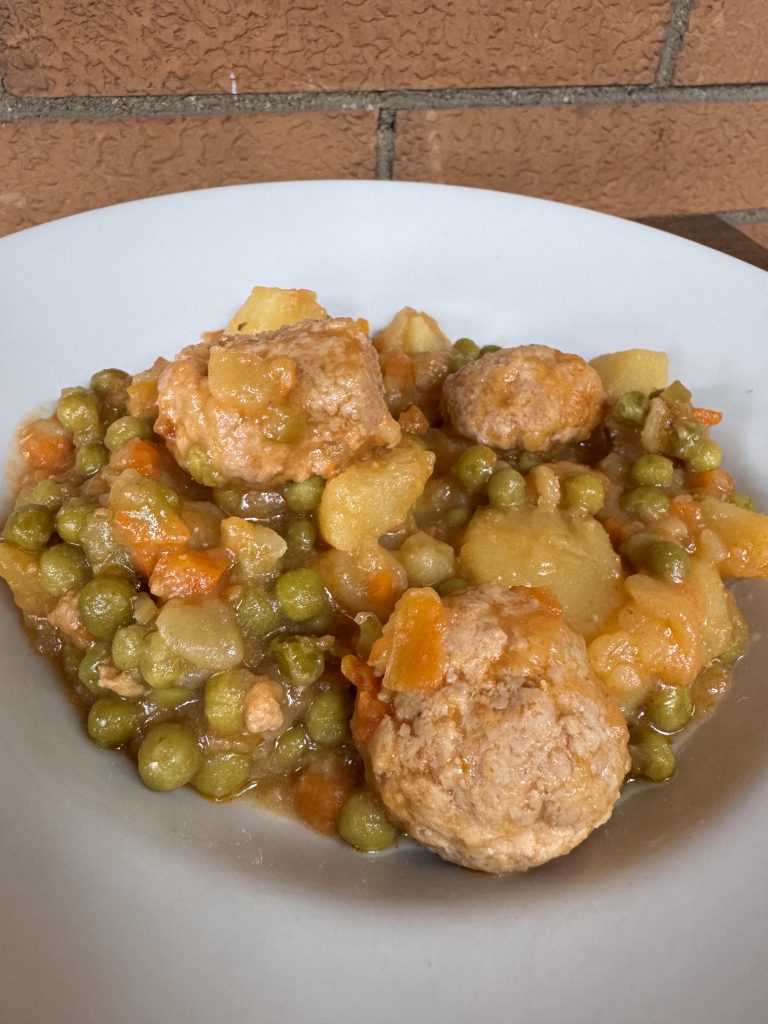
Meatballs stewed with potatoes and peas are a dish rooted in the centuries-old tradition of aggrassati. Essentially, aggrassato in the Palermo dialect refers to meat dishes that are slowly stewed in plenty of onions and wine.
Over the years, aggrassato preparations have often been paired with potatoes and, since modern times have given us frozen foods and therefore spring peas available all year round, with peas as well.
The potatoes, some of which are skilfully mashed against the side of the pot toward the end of cooking, together with the onions create a glossy, enveloping sauce. The peas add a touch of sweetness that is always welcome.
Regarding the etymology of the word aggrassato, as always when it comes to traditional Italian dishes, there is a fierce debate among three factions.
The first says that the word aggrassato has to do with fat (grasso). It therefore refers to the fact that, in the past, meat dishes were cooked not only in wine and onions but above all in abundant amounts of fat (often to soften meat that, in our latitudes, was not always very tender). Today we all use olive oil, because we care about our arteries, but until a few decades ago, the fat of choice was pork lard.
This leftover fat obtained from pig slaughter reminds us that in old kitchens nothing was wasted, and even less so when it came to the pig.
The second faction instead argues that the word aggrassato comes from the French glacé or à la glace, terms that indicate foods that are glossy, glazed, or cooked in such a way as to create a shiny sauce.
The idea is that the dish was “glossy” thanks to the caramelization of the onions, the wine, and the cooking juices, similar to the French culinary concept of glace (glace de viande, a glossy meat reduction).
This is plausible, not so much because Sicily was for a time under the Angevin French domination, but because for over two centuries the Monsù reigned in sicilian kitchens.
The Monsù were head chefs employed by noble Sicilian families (during the late 18th and 19th centuries). They were often trained according to French style of cooking or influenced by it, even if they were not always French citizens.
You will hear about them often on EatandAbout, because even today Sicilian cuisine owes a great deal to these gentlemen.
But the theory I personally like best regarding the origin of aggrassato is that of the chef and great connoisseur of Sicilian culinary history and traditions, Angelo Benivegna. According to Angelo, aggrassato is:
A dish born rich and nurtured in baronial kitchens, which then reached maturity in the most popular neighborhoods of Palermo, where, having lost the nobility of the meat cuts—not large loins, lamb legs, or roasts stewed in front of the great ovens for hours and hours, bathed only in old wine, the baronial Perpetuo—the meat, later completed with mountains of potatoes or other vegetables such as artichoke hearts, mushrooms, or asparagus, aggrassato became the quintessential way of cooking, at least until the arrival of tomato, the popular meats: offal and, in general, the “fifth quarter,” everything the barons’ kitchens discarded.
Perpetuo, the wine that the barons’ chefs used to cook aggrassati, was called so because it passed from generation to generation without interruption, never changing: as much wine as you took from the cask of Perpetuo, you replaced with wine from the latest harvest. Year after year, decade after decade, without ever changing, Perpetuo became part of a way of cooking that has been passed down since we were Greeks, when we mixed wine with water in large κρατῆρες (kraters), cooking meat as well as octopus in wine, Chtapòdi sto krassì, the stewed octopus, which we still taste today in Greek taverns.
From the aristocratic Olympus to popular kitchens, aggrassato also changed form a little. The monsù who cooked for the nobility had ovens. The poor housewives had to make do with the pot.
And in the pot, the potatoes tended to fall apart a little. But what might have seemed a flaw in the dish was, for the humble people of Palermo, actually a virtue. With what remained at the bottom of the pot (some fragments of meat, a few spoons of onion, potato, and wine sauce, now fused into an inextricable delight), the poor Palermitans began the next day to dress their pasta with it. Maccheroni, bucatini, or whatever you wanted, as long as it was generously topped with grated aged caciocavallo cheese.
Even today, pasta c’a grassa is one of the most beloved pastas in traditional Palermo trattorias. If you go to Palermo, look for it. You won’t forget it.
Now, let’s come to our meatballs. In theory, aggrassato should be made with a piece of stewing meat such as the loin (if we want to make it aristocratic) or with a poor cut or fifth quarter (if we want to make it working class).
The meatballs are a variation for the Palermo mother who wants to make the children happy, and it is a dish that I carry in my heart from my childhood, and that I make every time winter bites and makes us long for summer.
Here is the recipe.
Serving: 4
Prepping time: 20 minutes
Cooking time: 40 minutes
Buon Appetito!